
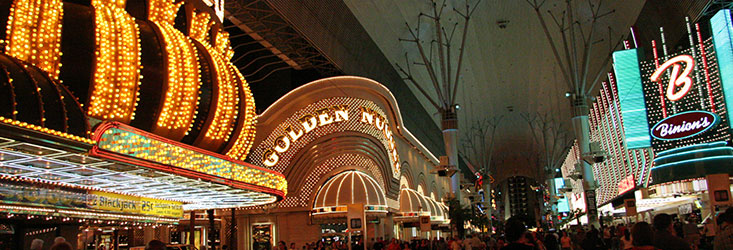

5.3 Downtown Las Vegas
The downtown area of Las Vegas is about a mile north of the Strip. It is the birthplace of legal gambling ...and Las Vegas itself. Today, most of the area is sort of run down. But it is still worth a visit. More than half of all visitors to Las Vegas (about 20 million people) come downtown during their trip, and reportedly downtown hotels, with a total of 8,200 rooms, run at 92 percent occupancy.
Three hotels that you might want to visit are Binion's Horseshoe, the Golden Nugget and The Plaza. All go back to the earliest days of Las Vegas gambling ...and all three were recently refurbished.
Binion's Gambling Hall and Casino
Steeped in Las Vegas history, the legendary Binion's Gambling Hall & Casino (at 128 E. Fremont Street) was the home of the annual World Series of Poker for nearly 35 years. Their Poker Hall of Fame gallery has photos of all the WSOP winners. It originally was called Binion's Horseshoe.
The property itself is one of the oldest in Las Vegas having been around for more than half a century. The original owner, Benny Binion, a shadowy Texas cowboy (and ex-convict) died in 1989. He descended on downtown Las Vegas in 1946, the same year that mobster Benjamin "Bugsy" Siegel opened the first casino (the Flamingo) on the Strip.
In 1998, Benny's son, Jack, sold his stake in Binion's Horseshoe to his sister Becky to settle a claim that he mismanaged the downtown property. That same year, another son, Ted (a heroin addict) was murdered.
Becky continued to run the business until 2004 when the casino fell upon hard financial times and sold out to Harrah's for about $50 million. In a separate transaction, Harrah's also purchased the outlying Horseshoe riverboat casinos operated by Jack Binion.
Harrah's then resold the downtown casino. The big prize for Harrah was the Horseshoe name and the World Series of Poker, both of which they retained. Today, WSOP is the largest and most prestigious poker tournament in the world.
This where the gamblers go! Binion's features twice-a-day no limit Texas Hold-em poker tournaments with only a $60 buy in ...also hand-dealt single deck blackjack and $2 craps, a rarity indeed in Las Vegas. (Be aware that blackjack only pays 6/5 - not 3/2!) Cost of rooms here used to be rockbottom ...but Binion's no longer rents guest rooms. The new owner TLCCasino Enterrprises, closed the property's hotel rooms, coffee shop and keno operations in a cost-cutting move.
The Golden Nugget
Directly across the street (at 129 E. Fremont Street) is the Golden Nugget. Simply said, it is the largest (nearly 2,400 rooms), classiest and highest rated hotel in the downtown area. Rooms are also the highest priced, but still less than those on the Strip ...sometimes lower than $50 a night. The Golden Nugget is 2011 AAA Four Diamond Award winner property and underwent a $300 million upgrade. It added a new $15 million tower in 2009.
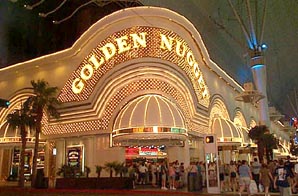
The Golden Nugget opened in 1946 as the first hall in Las Vegas constructed specifically for casino gambling. In 1973, legendary Steve Wynn transformed the Nugget's old seedy gambling saloon to a more luxurious, ornately decorated, white marble-floored resort ...his first hotel project.
Wynn is the man who reinvented Las Vegas. He moved there with his wife in 1967, just as Vegas was becoming a well-known gambling hotbed. He eventually went on to build the Mirage, Treasure Island, Bellagio and Wynn's/Encore Las Vegas mega-resorts on the Strip over the next 30 years.
Everything at the Golden Nugget appears gold-plated. You will want to see the world's largest gold nugget -- the Hand of Faith -- on public display in the lobby. It weighs nearly 62 pounds. And there is also another 13-pounder there, too.
In 2003, the Golden Nugget was acquired by Timothy Poster and Thomas Breitling, a couple of dot-com millionaires who had sold their online (Travelscape.com) site to Expedia in 2000. They tried to aim the property at high rollers and a younger crowd, but were less than successful. After owning the hotel for only 18 months, the pair sold the Golden Nugget again.
This time to Houston, Texas-based Landry's Restaurants in February 2005, their first venture into gambling. The company owns Landry's Seafood, the Rainforest Cafe, and Joe's Crab Shack restaurants around the country.
The Plaza
Another of the more famous downtown hotels is The Plaza at Number One Main Street. It is where Las Vegas history began.
In 1905, the San Pedro, Los Angeles and Salt Lake Railroad (absorbed by the Union Pacific in 1921) auctioned off more than a thousand lots. Because of its underground springs, "The Meadows," (Spanish for Las Vegas) was the name adopted for the desert railroad outpost linking the East with California.
In 1910, gambling was outlawed in Nevada. After legalized gambling returned to Las Vegas in 1931 and the Hoover Dam project got underway, saloons, brothels, boarding houses and gambling joints sprung up everywhere and Las Vegas got another adopted name: Glitter Gulch.
The Plaza, first called the Union Plaza, stood on the site of the original Union Pacific Railroad depot. Passenger trains used the terminal and The Plaza had the distinction of being the only railroad station in the world located inside a casino. In the '30s and early '40s, the Union Plaza is where people hung out.
The property was bought and rebuilt in the 1970s by hotel and casino legend Jackie Gaughan and the name was changed to Jackie Gaughan's Plaza Hotel. In 2004, Barrick Gaming purchased and began operating several downtown hotel-casinos including The Plaza.
Barrick restored and updated the property during 2010 and 2011. The south tower has now been fully renovated including all new furniture purchased from the postponed Foutainebleu project. The $35 million renovation included brand new guestrooms and suites, an entirely remodelled casino floor and lobby, and all new restaurants, bars and entertainment options. The property recently reopened. Stop by and take a look.
Fremont Street Experience
In the 1990's, lavish hotel-casinos erupted (literally) on the Strip and the downtown casinos had trouble keeping pace. Their answer (in 1994) was the Fremont Street Experience, a $70 million project to revitalize the downtown area.
Four blocks of Fremont Street -- from Main to Fourth Street -- was shut down to traffic and a huge covered pedestrian mall was built between the casinos. The 90-foot high latticed-steel canopy contained more than 2 million lights. At night the canopy becomes a free computer-driven animated light show with loud music. Its 200 speakers are powered by more than half a million watts!
The constantly changing themed light shows begin after sundown. A schedule of the downtown festivities can be found on the Freemont Street Experience website. There is one show an hour from about 8 p.m. to midnight. Each lasts 5 to 10 minutes. There are many retail shops and souvenir stands in the four block promenade to snoop around in while you are waiting for the next show to start ...even street performers and musicians who work for tips.
The Fremont Street Experience is the major tourist attraction in downtown Las Vegas and something that you should definitely see. Some say its the best free Las Vegas attraction.
Downtown Las Vegas Attractions
Downtown Las Vegas is a compact area of about a dozen older hotel-casinos and thousands of bright neon signs and flashing lights. The first neon sign went up in 1929. The most famous downtown landmark is a 40 foot tall waving neon cowboy named Vegas Vic. The Las Vegas Chamber of Commerce installed Vic on Fremont Street in 1951 to welcome visitors to what has become known as Glitter Gulch. He is still there.
And you will want to stop by the Golden Gate Hotel & Casino (at the corner of Freemont and Main) for its shrimp cocktail which it has been serving since 1959. (Available in the back delicatessen -- they want you to at least walk through the casino.) The Golden Gate celebrated selling its 25 millionth shrimp cocktail in 1991. It is now over 40 million!
On April 26, 2008, the price on the famous shrimp cocktail rose from 99 cents to $1.99, due to a rise in fuel costs; it was the first increase in seventeen years. To offer a trade-off, the casino now uses larger shrimp in the cocktail. Prior to the price increase, the casino lost about $300,000 a year on shrimp cocktail.
The Golden Gate is one of the oldest casinos in Las Vegas (1906) and still resembles a turn-of-the-century saloon. They also have $4.99 steak and eggs between midnight and 2 a.m. Trivia: In 1931 when gambling was legalized, this hotel was known as "Sal Sagev," (Las Vegas spelled backwards.)
The Las Vegas Club (at 18 East Fremont) has the city's most liberal and unique blackjack rules. Low minimums ($3 and $5) and you can split aces and pairs as many times as you want, surrender anytime, double down on any two, three or four cards ...and any six cards, totaling 21 or less, wins. They also permit hitting an extra card after splitting Aces. The Las Vegas Club installed the first neon sign on a casino in 1930. It was only the second such sign in the city.
Buying smokes from the Indians
A little known fact is that the Las Vegas Paiute Indians have a downtown smoke shop where tourists (and anyone else for that matter) can legally buy cheap cigarettes. The Las Vegas Paiute Tribal Smoke Shop at 1225 N. Main Street (Tel. 702-387-6433) is located near the Fremont Street Experience ...less than a mile north of the Main Street Casino. Federal, state and local taxes don't apply so they undercut the competition.
It is an interesting story how a small band of Paiutes got a tiny 10-acre reservation near downtown Las Vegas. In a nutshell, however, in 1905 a ranch owner who had befriended the Indians sold a few acres to the federal government for the permanent use of the Paiutes. In 1934, the Las Vegas Paiute Tribe was recognized as an independent body by the government and the ten acres became their reservation. It is considered a sovereign nation and politically independent of the state, so Nevada can not tax products sold by the Paiutes.
The tribe opened a tax-free smokeshop at North Main Street and Paiute Drive just outside of the reservation in 1983. To protect other downtown businesses from unfair competition, the tribe and the State entered into an agreement whereby the Paiutes would collect tobacco taxes "equal to, or greater than" the amount collected by the State. It allows them to sell at cost with the Paiute taxes being their profit. The lowest price on a carton of off-brand cigarettes is around $15. There are no sales taxes.
The Las Vegas Paiute Tribe (numbering less than 50 members) is now the largest single retailer of cigarettes in the United States. They have made millions over the years from the sale of tobacco products and each gets about $100,000 per year as their share of the proceeds.
NEXT PAGE: 5.4 OTHER ATTRACTIONS IN THE AREA.... ⇨